

Brazil has always been on the list. The question was when. In 2026, the answer arrived: Travel + Leisure named it Destination of the Year. Over 9.3 million international visitors arrived in 2025, a 37 percent increase over the year before, the highest number in the country's recorded history. New direct routes from the United States and Europe have made getting there easier than it has ever been. And across every platform where the world decides where to travel next, Brazil is the recurring answer.
But the Brazil people are going to and the Brazil that deserves to be on your itinerary are two different things. The crowds are in Rio. The discovery is elsewhere.
What follows is a guide to both: the cities worth your time, the coastline that earns the obsession, and the interiors that most visitors never find. We have also included where the Sandra Monokini belongs in all of it, because it is proudly Brazilian-made by women in Port Alegre. This swimsuit was designed for destinations worth remembering and it has no better proving ground than a country this vast and this alive.
Quick Facts
Primary Entry Points: Guarulhos International (GRU), São Paulo; Galeão International (GIG), Rio de Janeiro
Currency: Brazilian Real (BRL); exchange rates currently favorable for USD and GBP travelers
Language: Portuguese; English spoken in major hotels and tourist areas, limited elsewhere
Best Time to Visit: April through June (shoulder season, post-Carnival, cooler and less crowded); September through November (dry season in the northeast)
Visa: US and EU citizens currently do not require a visa for stays under 90 days; verify requirements before travel
Time Zones: Brazil spans four time zones; Brasília Time (GMT-3) covers most destinations in this guide
The Cities
Rio de Janeiro

Rio is the obvious entry point and for good reason. The city delivers on every piece of its mythology: the mountains descending into the sea, the beaches that function as neighborhoods, the particular energy of a place that has decided to live outdoors. In 2026, it is also having a genuine cultural moment. The National Museum of Fine Arts is hosting a major retrospective of Brazilian photographer Vicente de Mello through mid-year. The legendary Copacabana Palace is completing its most significant renovation in the hotel's history, adding expanded suites and a new spa. New Michelin-starred restaurants have arrived in the Zona Sul, and the food scene across Leblon and Ipanema has sharpened considerably.
Ipanema and Leblon remain the neighborhood anchors for anyone staying close to the water. For something more removed from the tourist circuit, the neighborhood of Santa Teresa, perched above the city on a hill of crumbling colonial architecture and independent restaurants, offers a version of Rio that moves at a different pace. The Vidigal favela, long accessible only to those who knew to look, now has a string of bars and viewpoints that make the climb worth the effort.
 A note on timing: Rio's summer (December through March) is glorious and extremely crowded, particularly around Carnival in February. If the beaches are the goal without the festival crowds, April and May offer warm water, quieter streets, and considerably lower prices.
São Paulo
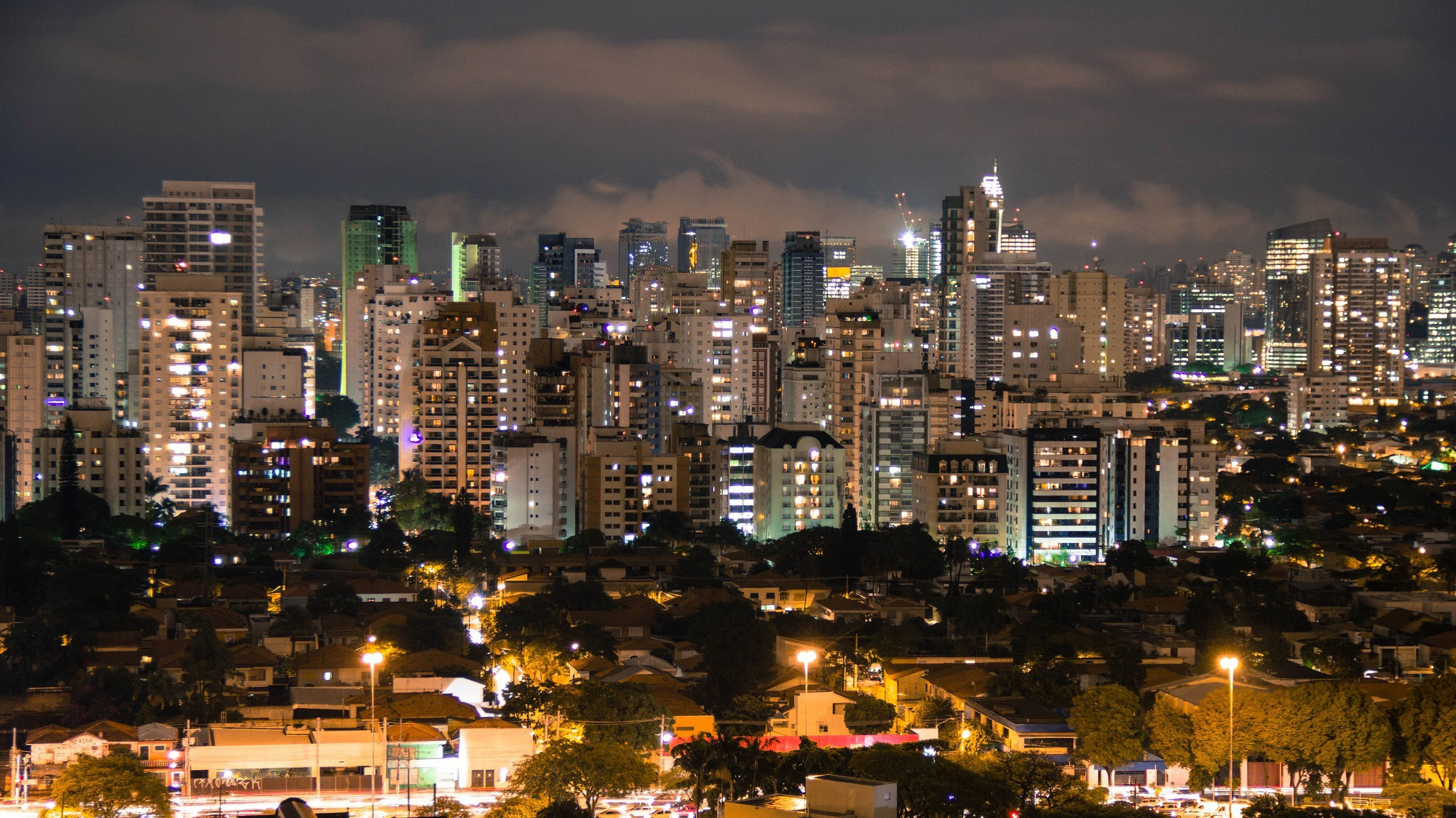
São Paulo does not try to be beautiful. It tries to be interesting, and it succeeds. The city is Brazil's economic and creative center, home to the continent's most sophisticated dining scene, its best contemporary art institutions, and a nightlife culture that has no real equivalent in South America. MASP, the Museu de Arte de São Paulo, sits on Avenida Paulista with its iconic glass-and-concrete structure suspended above the street, its collection spanning six centuries and five continents. The neighborhood of Vila Madalena covers its buildings in murals. The Pinheiros district has become what Williamsburg was in its best years: creative, walkable, and not yet ruined by it.
Belém, the northern port city at the mouth of the Amazon, deserves a mention alongside São Paulo as a gastronomic destination. Travel + Leisure singled it out specifically: the city's cuisine, rooted in Amazonian ingredients, has drawn serious international attention in the past two years. Dishes built around tucupi, a fermented yellow broth extracted from wild manioc, and jambu, an herb that creates a gentle tingling sensation in the mouth, are unlike anything found anywhere else. For the traveler who moves through the world with a serious appetite, Belém is worth a trip of its own.
The Coast
Bahia
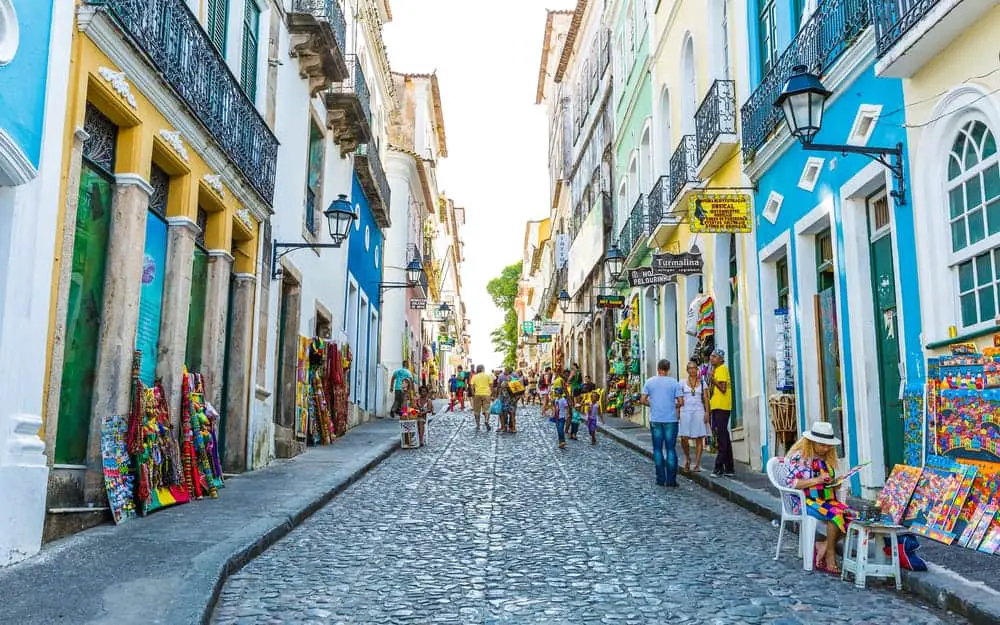
The state of Bahia contains everything the rest of Brazil promises. Its capital, Salvador, is the oldest city in the Americas founded by Europeans and the cultural center of Afro-Brazilian life. The Pelourinho, its historic center, is a UNESCO World Heritage Site: cobblestoned streets lined with pastel buildings, iron-balconied colonial churches, the smell of dendê oil and the sound of percussion from the windows above. This is where samba began. Where Candomblé, the West African spiritual tradition that survived the Middle Passage and planted itself in the soil of the Northeast, is still practiced openly and with ceremony.
Further up the Bahian coast, past the resort clusters of Praia do Forte and Itacaré, the pace changes entirely. The Dendê Coast, a stretch of shoreline south of Salvador accessible only by boat or four-wheel drive, holds a concentration of deserted beaches, fishing villages, and mangrove forests that most visitors to Brazil never see. The town of Boipeba, reachable by a two-hour boat journey from Morro de São Paulo, operates without cars and with limited electricity. It is, in the most genuine sense of the phrase, a place the world has not yet found.
The Sandra Monokini was designed for a coast exactly like this one. The Bahia colorway was drawn from it directly: warm earth tones, the deep terracotta of the region's colonial architecture, the rich ochre of its light at four in the afternoon. Pack it for Boipeba, for the boat trip down the Dendê Coast, for a morning on the black sand beaches of Itacaré before the sun gets too high.
Fernando de Noronha

Three hundred and fifty kilometers off the coast of Recife, in the middle of the Atlantic, lies an archipelago of 21 volcanic islands that Brazil has the good sense to protect from the thing that would ruin it. Fernando de Noronha caps its daily visitors at 500. Every traveler pays an environmental preservation tax upon arrival, graduated by length of stay. The infrastructure is minimal by design.
The result is the most extraordinary stretch of water in South America. Sancho Bay, consistently ranked among the most beautiful beaches in the world, earns the designation: a cove reachable only by descending a narrow cliff trail or arriving by boat, its water shifting from green to cobalt depending on the angle of the light. Spinner dolphins gather in Baia dos Golfinhos in the mornings in numbers that have to be seen to be calibrated. Sea turtles nest on the beaches from December through June. The diving here, particularly around the Cabeço dive site, is among the best in the Atlantic.
Getting to Noronha requires a flight from Recife or Natal. Book well in advance: the visitor cap means accommodation books out months ahead during peak season. It is the kind of place that justifies an itinerary built around it.
The Northeast: Jericoacoara and Lençóis Maranhenses
The further northeast you travel along Brazil's coast, the stranger and more beautiful the landscape becomes. Jericoacoara, a village in the state of Ceará that is accessible only by dune buggy across a stretch of sand that was once roadless, has become the country's kitesurfing capital without entirely losing the quality that made people want to come in the first place. The streets are still sand. There are still hammock bars facing west for the sunset. The dunes rise high enough that the climb produces a view worth the effort.
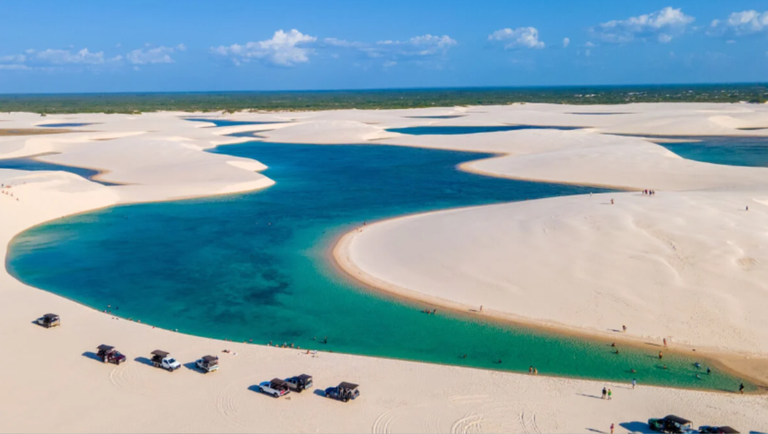
Further east, in the state of Maranhão, lies a landscape with no real equivalent on earth. Lençóis Maranhenses, a national park of white sand dunes stretching to the horizon, fills every low point between its dunes with a lagoon during the rainy season. The result is something that does not photograph correctly: thousands of turquoise pools appearing in the gaps between endless waves of pale sand, the horizon nothing but dunes in every direction. The rainy season runs roughly from January through June, which is also when the lagoons are fullest. Visit between May and August for the peak of the water.
The Interior
Chapada Diamantina
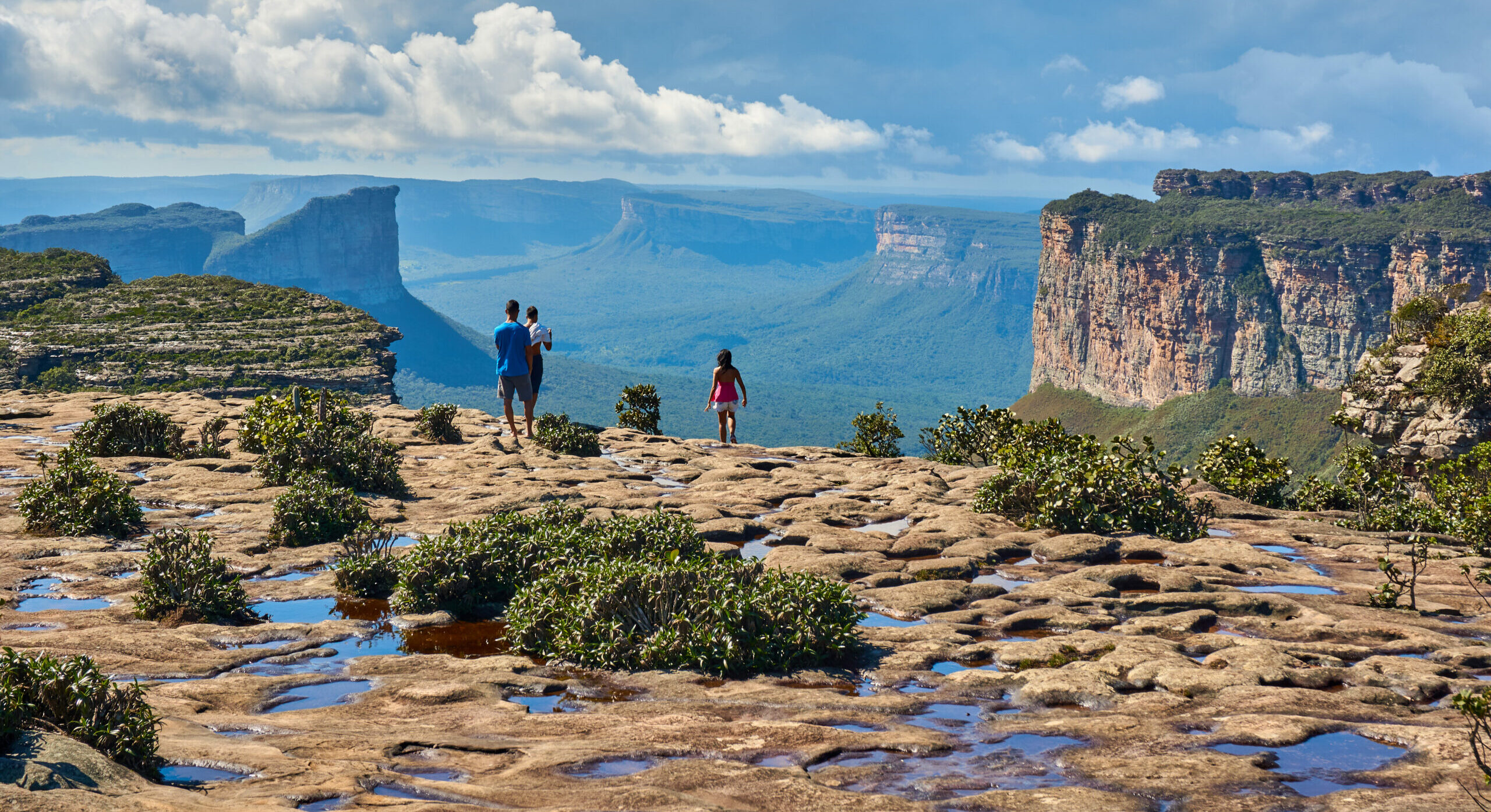
In the interior of Bahia, inland from Salvador by six hours of driving, the landscape rises into something that resembles no other part of Brazil. The Chapada Diamantina is a national park of table-top mountains, black-water lagoons, waterfalls that drop hundreds of meters into gorges, and cave systems with crystal pools glowing blue from the light filtering through the rock above. The town of Lençóis, the park's main gateway, is a colonial market town of considerable charm, with a handful of excellent pousadas and a guide community that knows every trail in the region.
The best of the park requires walking. The hike to Poço Encantado, a cave pool lit for two hours each day by a shaft of light that turns the water an electric blue, is thirty minutes each way and requires a boat. The hike to Cachoeira da Fumaça, the park's tallest waterfall, takes three hours from the trailhead. For those willing to spend several days, the Trilha do Vale do Pati, a multi-day circuit through remote valleys accessible only on foot, is among the great wilderness walks in South America.
The Pantanal

The Pantanal is the world's largest tropical wetland, a flat expanse of marshes and grasslands in the state of Mato Grosso do Sul that floods each rainy season and transforms into a landscape of such density with wildlife that serious naturalists consider it a superior destination to the Amazon. Jaguars are reliably spotted here in a way they are not in the dense forest further north. Giant otters, capybaras, caimans, and 650 species of birds share the wetlands. The Caiman Ecological Refuge, which opened its Cordilheira Lodge to guests in 2026, offers what is currently the most beautifully designed and ecologically rigorous lodging experience in the Pantanal, bookable only on a private-use basis.
The Pantanal is the kind of destination that changes what a luxury trip means. There is no beach and no city. There is water and grassland and a sky so large and so active with birds that you stop trying to name them and start simply watching. It is, without apology, the most alive place in Brazil.
Practical Information
Getting There
São Paulo's Guarulhos International Airport (GRU) is the primary international gateway. United Airlines now flies direct from New York, and Emirates and Qatar Airways have added Brazil to their networks, making connections through Dubai and Doha viable for travelers coming from anywhere. TAP Air Portugal offers strong connectivity through Lisbon, including new routes to Fortaleza and Recife that open the northeast to direct European access. Rio's Galeão Airport (GIG) is the second major entry point; arrivals there are up 43 percent year-over-year, and the airport has expanded accordingly.
Getting Around
Brazil is enormous. The distances between its great destinations are not road-trip distances; they are flight distances. Budget for domestic flights as a core travel expense. LATAM and Gol cover the domestic network extensively. For the northeast specifically, flying into Recife or Fortaleza and renting a car or hiring a driver for the coast gives the most flexibility. Fernando de Noronha requires a connecting flight from Recife or Natal.
When to Go
The answer depends entirely on which Brazil you want to see. Carnival, in February, is an experience with no equivalent in the world; it is also the most crowded and expensive moment to be in Rio or Salvador. The shoulder seasons, April through June and September through November, offer the best combination of weather, manageable crowds, and prices that have not yet absorbed the high-season premium. The northeast coast, including Jericoacoara and Lençóis Maranhenses, is best visited between May and August. The Pantanal is most spectacular from June through September, as the dry season concentrates wildlife around shrinking water sources.
What to Pack
The Sandra Monokini in Bahia is the only swimwear this coastline requires. The colorway was drawn from the light and earth tones of the Brazilian northeast, and it reads exactly right against the dark water of the Bahian beaches, the sand of Jericoacoara, and the turquoise lagoons of Lençóis Maranhenses. For the deeper waters of Fernando de Noronha, the Tahiti colorway, in its blue-green register, suits the Atlantic at its clearest. Both are made in Brazil by a women-owned factory, a detail that feels relevant when the destination is the country that produced the fabric.